Translate
Wednesday, March 15, 2017
Monday, March 13, 2017
Pink
I don't have source for this artifact.
However, the video below shows another textile and offers a source.
1920, Paper Doll Baby Bobby.
The march toward gender-specific clothes was neither linear nor rapid. Pink and blue arrived, along with other pastels, as colors for babies in the mid-19th century, yet the two colors were not promoted as gender signifiers until just before World War I—and even then, it took time for popular culture to sort things out.In 1927, Time magazine printed a chart showing sex-appropriate colors for girls and boys according to leading U.S. stores. In Boston, Filene’s told parents to dress boys in pink. So did Best & Co. in New York City, Halle’s in Cleveland and Marshall Field in Chicago.
Today’s color dictate wasn’t established until the 1940s, as a result of Americans’ preferences as interpreted by manufacturers and retailers. “It could have gone the other way,” Paoletti says.
So the baby boomers were raised in gender-specific clothing. Boys dressed like their fathers, girls like their mothers. Girls had to wear dresses to school, though unadorned styles and tomboy play clothes were acceptable.
Above text source smithsonianmag.com. Go to link to read full article.
Yellow
Lascaux Cave, Yellow Ochre
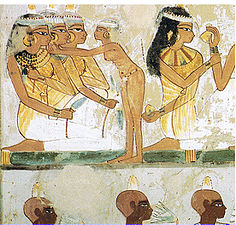
Paintings inside Tomb, Ancient Egypt, 15th century BC
Yellow Badges, Jews required to wear in Nazi-occupied Europe.
Read about it here, Holocaust Encyclopedia.
Bermuda Buttercup
Yellow Ochre quarry in France.
Yellow School Bus
Wednesday, March 8, 2017
Marco Tirelli, Artist
Marco Tirelli grew up at the Swiss Institute in Rome, surrounded by visiting scholars and artists. His father was the manager and he family lived there (at the Institutes’s 19th Century Villa Maraini) in an apartment. His talent as a draftman took little time to show and he was already assigned a studio at the Villa Maraini at the age of 15.
Living at the Villa Maraini was a strong influence on his personal and artistic development : “So I’m a rather strange Roman,” he said. “I grew up here, but I never felt entirely part of it. And this has had a big effect on my work because I’ve always sensed a tension between places, real places, and what lies unseen beyond.”
Tirelli studied set design with Totj Scialoja at the Fine Arts Academy in Rome and he is an admirer of theatrical designer Adolphe Appia, whose work is echoed by Tirelli’s geometric and dramatic painting.
The metaphysical visions of the artist are expressed in a wide variety of styles and media: from paintings of geometric objects with dramatic lighting and contrasts, to drawings and sketches, to tiny sculptures of scenes. A collection of his work has been presented at the 2013 Art Biennale of Venice.
Barbara Rose wrote in her column in the Wall Street Journal: “An accomplished painter, sculptor and draftsman, Mr. Tirelli treats the theme of memory in a precise and evocative manner. Drawings of the images he uses in his metaphysical abstract paintings alternate with three-dimensional maquettes of imaginary buildings that suggest a metaphysical time and place.”
source link here
Labels:
Memento Artist Inspiration
Subscribe to:
Posts (Atom)