Translate

Showing posts with label Dinner and A Movie Color In Film. Show all posts

Friday, March 1, 2019

Color in Film

  • Cinematography is an important part of the filmmaking process. 
  • Color in film can build harmony or tension within a scene. 
  • Color is often an extremely powerful tool communicate emotional ideas to the audience.
  • Color can affect audience emotionally, psychologically and even physically.  

When telling a story, color can:
  1. Elicit psychological reactions with the audience.
  2. Draw focus to significant details.
  3. Set the tone of the movie.
  4. Represent character traits and more.
  5. Show changes or arcs in the story.
Forrest Gump


Grease


Harry Potter and the Deathly Hallows Part 2


Inception


Life of Pi


Mad Max: Fury Road


Spirited Away


The Hunger Games: Mockingjay Part 2


The Truman Show


The Theory of Everything


The Avengers


Alice Through The Looking Glass


Go to the link below to see more color palettes. 
Source:


Also, a video about color film. Many are available to watch online so feel free to continue to search. You may find a video that specifically discusses the movie you selected. 


Wednesday, October 17, 2018

10 Best Uses of Color of All Time

Color is one of the most effective tools in a storyteller's arsenal. From fiery red, to the coldest blue, a great filmmaker knows just what colors to paint on the screen. Move over light and shadow, lets take the color wheel for a spin! Here are the very best uses of color in a movie ever!


Sunday, June 24, 2018

Color Psychology in Film

Below are examples of how color is used in film making. 

     Color psychology, is defined as the study of hues as a determinant of human behavior. Color evoke emotion in our brains. It’s been proven time and time again that hues of blue are most often associated with cool, calm feelings, while stronger colors like red stir up strong, aggressive emotions. It’s these underlying perceptions that help photographers and cinematographers alike bring about a certain feel and aesthetic to a particular image, be it still or motion.
      In the four-minute montage, Mtz-Seara explores vimeo.com  innocence, passion, insecurity, sociability, madness, eroticism, and more as the colorful video transitions from one masterful scene to another. From David Fincher’s Fight Club to Wes Anderson’s The Grand Budapest Hotel, the video shows how clever use of colors and composition subconsciously evoke emotions as the respective directors and cinematographers create and capture the scenes of a film. 
Text and image source:https://wecommunication.blogspot.com/2018/01/how-can-color-tell-story-color-theory.html
Yellow Dick Tracy
dick-tracy-use-of-colour-in-cinema-e1448309818276.jpg
Yellow is the color of caution, it brings power, energy and anxiety. Dick Tracy wears a bright yellow coat and hat, the screen becomes energized whenever Tracy enters. The color is brash, daring, it is the color of obsession , there is a reason poisonous reptiles have yellow skin. Tracy is the obsessive detective caught up in his case . 


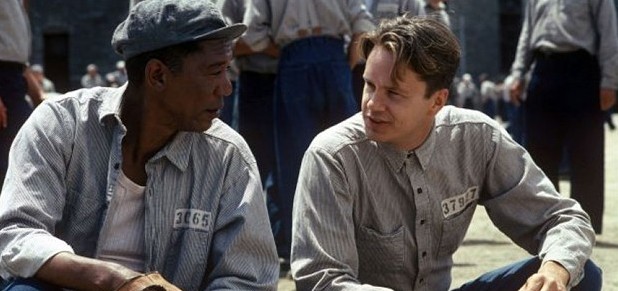
 Blue Shawshank Redemption
Blue can be a tranquil pond or a soft blanket of sadness. Throughout Shawshank the film is surrounded by the color of blue. A smog of grey blue surrounds the film. Shawshank is a film of sadness, and is this emotion that cinematographer Roger Deakins wanted the audience to feel throughout the film. That we are amongst the prisons. When Andy escapes the prison he finds his friend Red on an island, with vibrant green land – the first time vivid colors have been used throughout the film.  

Orange The Godfather

Orange is the welcoming color, warm sunsets and Halloween pumpkins.  In the opening scene of The Godfather the Don’s office is lit with an amber and orange light. The film is lit romantically with pastel orange shades. Throughout the film the orange shades turn more red as more is revealed within the crime underworld. 

 Green Crouching Tiger Hidden Dragon

Green can signal health, danger or decay. It is the color of fresh vegetables and spoiled meat. In Crouching Tiger Hidden Dragon Jen and her master Li Mu Bai are about to have a fight in a green vibrant bamboo forest. The fight is non-violent Jen’s master is afraid that Jen is turning evil, he chases her through the forest, she disappears diving into a green lake. The oppositional nature of green plays a significant part in the story. 

Purple Chicago

Purple the color of mystery, the paranormal and death.In Chicago purple is used to show both death and delusion. Roxy stands on stage she looks out into the crowd purple light covers her and the piano player. Roxy is imagining that she is a famous singer, the story is about the glamorization of criminals. Purple is consistent throughout the deaths that take place in the film.

Saturday, December 17, 2016

Wes Anderson, Color Palettes


The fictional worlds evoked in film by director Wes Anderson have such a precise colouration – the very particular pastel-hues that paint the skies, drench the buildings and dress the characters, render Anderson’s microcosms almost dream-like. The hazy-hued lens through which we peer into the director’s unique world has a retro quality that casts his films in a nostalgia for a time that could have been. The muted pink of The Grand Budapest Hotel that makes the hotel itself the biggest character in the movie; the very particular French mustard that comes to define Gwyneth Paltrow’s Margot Tenenbaum in The Royal Tenenbaums; the vintage boy-scout green in Moonrise Kingdom – all of these hues are captured in the Wes Anderson Colour Palettes Tumblr, which breaks down the shades that colour Wes’s world scene by scene with precise accuracy, and also the Movies in Color site, which considers individual frames of many films, including Anderson's, distililng them down to their myriad different shades.   


The Darjeeling Limited, 2007


Artist and Wes Anderson enthusiast Hamish Robertson says, “Anderson's colour palettes are integral to his cinematic ‘world-building’. His eye for art direction and fantastic attention to detail creates the appropriate space and tone for his characters to exist in – and for the viewer to lose themselves in. They ultimately become their own visual language, the way character themes are elaborated in cinematic scores, allowing an immersive visual experience whether the sound is on or not.” Text


Moonrise Kingdom, 2012


The Grand Budapest Hotel, 2014
The muted pink of The Grand Budapest Hotel 
makes the hotel itself the biggest character in the movie.


Fantastic Mr Fox, 2009

Source is anothermag.com
http://www.anothermag.com/art-photography/3586/wes-andersons-colour-palettes


Go to the link below to see 50 more movies with palettes. 

SaveSave